
The Indian rupee plummeted to a new all-time closing low of 95.81 against the US dollar, driven by surging crude oil prices, persistent inflation concerns, and a strengthening dollar index.

New capital exposure norms implemented by the Reserve Bank of India (RBI) from July 1 have led to a noticeable drop in trading volumes, with Multi-Commodity Exchange (MCX) options premium ADTV falling by nearly 40 per cent in early July.

Gwadar is viewed as a critical pearl in China's maritime strategy as it would give a permanent logistical footprint near an important choke point - the Strait of Hormuz and the oil rich Persian Gulf, explains Commodore Venugopal Menon (retd).

Asian Development Bank (ADB) on Friday warned that India's limited crude oil reserves of about 100 million barrels - sufficient for only 40-45 days of consumption - leave the country particularly vulnerable to supply disruptions through the Strait of Hormuz amid the ongoing war in West Asia.

India's wholesale price inflation (WPI) increased to 9.87 per cent in June, up from 9.68 per cent in May, primarily due to significant price increases in non-food and food products, with food inflation alone rising to 5.49 per cent.

Not a single retail outlet ran dry. Every household that wanted a cylinder got one. India faced neither a 1991 moment nor a 2013 one. Macroeconomic stability held. This was not an accident, and it was not luck alone. It was the work of a government that chose to act as it had during the pandemic -- deliberately and gradually, building one measure upon another rather than reaching for a single dramatic lever, explains V Anantha Nageswaran, chief economic advisor to the Government of India.

Inflows into foreign currency non-resident (bank), or FCNR (B), deposits have significantly underperformed market expectations, leading to a more than 1 per cent depreciation of the rupee against the dollar this week. Analysts point to fading RBI support measures, tepid interest due to rising global bond yields, and narrowing interest rate spreads compared to 2013 as key challenges.

Private-sector oil refiner Reliance Industries Limited (RIL) last week received a general licence from the United States (US) government to buy Venezuelan oil, an industry executive said.

India's finance ministry anticipates inflation will remain relatively contained in the coming months, supported by a correction in crude oil prices and softening input costs following the cessation of the West Asia conflict, despite earlier spikes in wholesale and retail inflation.

Global oil prices fell on Thursday to their lowest levels since before the outbreak of the Iran conflict, offering a significant economic tailwind for India, the world's third-largest crude importer, by easing inflation risks, reducing the import bill and improving the government's fiscal position.

Indian stock markets are poised for volatility this week, driven primarily by the outcomes of five state assembly elections, ongoing high crude oil prices amid West Asia tensions, and the release of Q4 corporate earnings, according to market analysts.
The Madhya Pradesh government has formed a committee to monitor gas and oil supplies amid concerns over the West Asia crisis, assuring citizens that there are adequate stocks and no need to panic. The government is also working to ensure the safe return of Indian citizens from Gulf countries.

Indian benchmark indices Sensex and Nifty experienced a significant slump in early trade, driven by a sharp surge in crude oil prices above USD 120 per barrel, weak global market trends, and continued foreign fund outflows.

Insights from behavioural economics suggest that an ambitious nudge can be effective if three conditions are met, points out Ram Singh Insights from behavioural economics suggest that an ambitious nudge can be effective if three conditions are met, points out Ram Singh, director, Delhi School of Economics.
The Reserve Bank of India (RBI) has projected that crude oil prices will average USD 85 per barrel and the rupee will weaken to 94 against the dollar by FY27, according to its bi-annual Monetary Policy report.

Indian stock market benchmark indices Sensex and Nifty rebounded in early trade, driven by a decline in crude oil prices, supportive global cues, fresh foreign fund inflows, and buying in blue-chips like Reliance Industries and HDFC Bank. Track Sensex, Nifty movement on June 22, 2026.

Peak performances in football begin years before kick-off. From Kylian Mbapp, Lionel Messi to Erling Haaland, the sport's biggest names follow ultra-disciplined routines to stay fit throughout the season.

Cairn Energy of UK on Monday said its oilfield in Rajasthan contains more than 2.5 billion barrels of oil reserves.

Indian benchmark equity indices, Sensex and Nifty, extended their rally for a fifth consecutive session, driven by optimism surrounding a potential US-Iran peace deal and a significant drop in crude oil prices. Despite hawkish remarks from the US Fed, investors remain hopeful that easing energy prices could temper inflationary pressures.
The Congress party is set to challenge the Modi government on a range of critical issues, including alleged theft of Ram temple donations, 'systemic corrosion' of the education system, and constitutional amendment bills related to delimitation and dismissal of ministers, during the upcoming Monsoon Session of Parliament.

India's wholesale price index (WPI) inflation surged to 9.68 per cent in May, up from 8.26 per cent in April, primarily due to significant increases in the prices of fuel and power, manufactured goods, and food items.

Despite the Reserve Bank of India's (RBI) and the government's recent initiatives to attract foreign capital, which are expected to alleviate pressure on long-duration bonds, most debt fund managers are maintaining a cautious stance, favouring shorter-duration papers due to global uncertainties and potential future rate hikes.
We present here a list of countries with highest proven oil reserves.

The Asian Development Bank (ADB) has revised down India's GDP growth forecast for fiscal year 2026-27 (FY27) to 6.6 per cent from an earlier 6.9 per cent, primarily attributing the change to elevated energy prices stemming from the Middle East conflict. Despite this moderation, India is still expected to remain the world's fastest-growing major economy.

Bessent indicated that the U.S. is evaluating the status of Iranian oil as the current campaign progresses.

The Indian equity market is set for an event-heavy week, with analysts pointing to the Reserve Bank of India's (RBI) interest rate decision, developments in the US-Iran situation, and crude oil prices as the primary determinants of market trends.

India is building its oil reserves in underground rock caverns and tanks

S&P Global Ratings projects India's economic growth to slow to 6.6 per cent in FY27, down from 7.7 per cent in FY26, citing energy stress and a potential sub-par monsoon.

Monthly gold imports have declined to 25-30 tonnes from 70-80 tonnes while recycling of old jewellery has increased following the recent hike in import duties.

'What exactly is on the prime minister's mind, we do not know. But it feels like the government wants the country to be prepared for unseen challenges ahead.'
Crude oil prices are expected to rise this year as Iranian oil sanctions will lead to a drop in oil supply.

'India has initiated a bear market and we will still go lower. It has nothing to do with the economy.'

Most members of the Reserve Bank of India's Monetary Policy Committee (MPC) expressed concerns about inflation becoming generalised and highlighted uncertainties surrounding both inflation and growth prospects due to the West Asia conflict, according to the recently released minutes.
The International Energy Agency (IEA) has proposed immediate demand-side measures, including remote work, lower speed limits, and reduced air travel, to mitigate the impact of a global oil supply shock caused by Middle East disruptions.

A US-sanctioned tanker carrying Iranian crude oil has rerouted mid-voyage from its previously indicated destination of India to China, raising questions about payment issues and the future of India's Iranian oil imports.

India is well-stocked with inventories of crude oil and key petroleum products, including petrol, diesel, and aviation turbine fuel (ATF), to deal with short-term disruptions as the war intensifies in West Asia, Union Minister of Petroleum and Natural Gas Hardeep Singh Puri said on Tuesday.

The Indian rupee crashed to a record closing low against the US dollar due to rising global crude oil prices, a strengthening dollar, and geopolitical tensions in the Middle East.
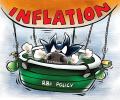
The Reserve Bank of India has increased its retail inflation projection for 2026-27 to 5.1 per cent, up from an earlier estimate of 4.6 per cent. This revision is primarily attributed to mounting input costs, driven by the pass-through of higher global energy prices to domestic petrol and diesel rates, which have seen significant increases since May.

When asked about Bessent's announcement allowing certain Russian oil sales to India and whether the US is considering any other moves, including tapping the Strategic Petroleum Reserve (SPR), Trump said, "If there were some, I would do it just to take a little of the pressure off."

Indian benchmark indices, Sensex and Nifty, closed almost flat in choppy trade as investors remained cautious due to ongoing uncertainty in West Asia, relentless foreign fund outflows, and anticipation of the RBI's monetary policy decision.
